
How to Create a Lawyer Letterhead: Professional Letterhead Design Ideas & Legal Branding Tips
Lawyer Letterhead Introduction
In the world of legal documentation, a lawyer’s letterhead is far more than just a piece of paper—it’s a powerful symbol of authority, credibility, and professionalism. Whether you’re an independent attorney or a partner in a reputed law firm, the letterhead you use sets the tone for every communication with clients, colleagues, courts, and government departments.
So, what exactly is a letterhead? In simple terms, a lawyer letterhead is the top section of a formal legal document that includes essential details like your name, designation, contact information, office address, and credentials. Think of it as a professional business card built directly into your document—a subtle yet vital reflection of your legal identity.
The legal profession thrives on trust and presentation, and something as simple as a professional letterhead design can make a significant difference in how your communication is perceived. Imagine receiving two legal notices: one typed on plain paper and another on a neatly formatted letterhead that displays the lawyer’s credentials and firm details. Which one would inspire more confidence?
In this guide, we’ll break down everything you need to know about lawyer letterhead format—from must-have components and layout ideas to professional letterhead design tips, tools, and printing advice. Whether you’re creating your first letterhead or upgrading an existing one, this article is your complete companion to crafting a design that truly represents your legal professionalism.
Let’s dive into the details.
What Is a Lawyer Letterhead and Why It Matters
A lawyer letterhead is the formal header printed or digitally placed on top of legal correspondence. It identifies the lawyer or law firm behind the communication and instantly conveys authenticity. A typical letterhead includes the lawyer’s full name, professional title, registration or Bar number (where applicable), office address, contact information, and sometimes the firm logo or tagline.
In essence, your lawyer letterhead functions as a legal signature before a single word of your message is even read. It reassures the recipient—whether a client, court official, or government department—that the document originates from a credible legal professional.
In the legal world, presentation equals trust. A well-designed letterhead signals professionalism, discipline, and attention to detail—the same qualities clients expect from their attorney. On the other hand, a poorly formatted or outdated design can silently undermine your image, even if your legal argument is flawless.
That’s why investing time in creating a professional letterhead design isn’t vanity—it’s part of building your professional identity as a lawyer.

Essential Elements of a Lawyer Letterhead
A lawyer letterhead must strike the right balance between professionalism, clarity, and compliance. Each element on the page should serve a purpose — presenting your identity and building trust at first glance. Whether you’re designing it for print or digital use, here are the components every lawyer or law firm should include.
- Lawyer’s Full Name and Title
Your name should appear clearly at the top, followed by your professional designation — for example, Advocate, Attorney-at-Law, or Legal Consultant.
If you’re part of a firm, include the firm’s registered name just above or below yours. Consistency in spelling and format builds credibility.
- Qualifications and Bar Registration Details
Mentioning your Bar Council enrollment number (in India) or State Bar License number (in the USA) adds legitimacy to your documents.
Optional additions like degrees (LL.B., LL.M., etc.) can be placed in a smaller font size below your name.
- Office Address
Include your official office address — ideally the one registered with your professional body.
Keep it clean, one or two lines maximum. Avoid adding multiple branch addresses unless you represent a large firm.
- Contact Information
Provide at least two modes of contact:
Phone number (with country/area code)
Email address (preferably official domain-based, e.g., info@aswallaw.com)
You can also include your website URL if applicable.
- Logo or Firm Emblem
A small, professionally designed logo helps distinguish your legal documents from generic templates.
Keep it subtle — top-left or top-center placement works best. Avoid large or colorful logos that distract from the text.
- Tagline or Practice Area (Optional)
If you specialize in a particular area — such as Civil & Corporate Law or Banking & Finance — include it below your name or firm name in smaller type.
It quickly communicates your expertise without cluttering the design.
- Footer Details
The bottom section can include:
Additional contact info (secondary phone, email)
Office timings (optional)
Confidentiality notice for professional communication
Pro Tip:
Maintain uniform margins, consistent typography, and balanced spacing. A well-aligned letterhead projects discipline — a core quality every client expects in a lawyer.
Creating a professional letterhead design goes beyond adding your name and logo—it’s about shaping how your communication is perceived. In the legal field, where trust, precision, and presentation matter deeply, your letterhead design should mirror those same values.
Here are some expert-backed design principles every lawyer or law firm should follow.

- Keep It Minimal and Elegant Simplicity is key. Avoid unnecessary borders, patterns, or color blocks. A clean layout with ample white space not only looks professional but also keeps focus on the content of your legal document.
- Choose Professional Fonts Typography silently communicates professionalism. Stick to classic fonts such as Times New Roman, Garamond, Georgia, or Lato. Use one primary font for headings and body text and avoid decorative or script fonts that can make your letterhead look informal.
- Use a Subtle Color Scheme The best lawyer letterhead designs usually rely on neutral, authoritative colors — black, navy blue, dark grey, or maroon. These shades convey seriousness and reliability. Use color sparingly — perhaps only in your logo or firm name.
- Maintain Proper Hierarchy and Alignment Structure matters. The reader’s eye should naturally move from your name → contact details → the body of the document. Align text neatly, keep margins equal on all sides, and ensure spacing looks balanced on both print and digital versions.
- Include Your Logo Thoughtfully If you have a law firm logo, place it on the top-left or top-center of the letterhead. Ensure its high-resolution and consistent with your branding across all materials — business cards, envelopes, and website headers.
- Design for Both Print and Digital Use Your letterhead should look sharp whether printed or shared as a PDF. Use a 300 DPI high-quality file for print and a lightweight digital version for email correspondence or e-filings.
- Maintain Consistency Across Documents Your letterhead should be part of a cohesive visual identity — meaning the same fonts, colors, and logo usage across.
Legal notices
Cover letters
Client communications
Consistency builds brand recognition and trust.
Pro Tip:
A professional letterhead design doesn’t need to be fancy — it needs to be flawlessly structured and legally appropriate. Think of it as your personal brand signature in the legal world.
Branding Tips for Legal Professionals

Your lawyer letterhead is more than a formal requirement — it’s a cornerstone of your professional brand. Every time a client, court, or colleague sees it, they form an impression about your reliability, attention to detail, and overall practice standards. A well-crafted professional letterhead design helps you project the right image — one that communicates confidence and integrity.
Here are a few proven branding insights every lawyer should apply.
- Define Your Legal Identity
Start by deciding how you want to be recognized — as an independent advocate, a specialist in a specific field, or a law firm brand.
Your letterhead should visually represent that identity.
For example, a corporate law firm may prefer a modern, minimal layout, while a senior advocate might use a more traditional, formal design.
- Use Consistent Branding Across All Materials
Your brand identity doesn’t end with your letterhead.
Carry the same fonts, color palette, and logo style across:
Visiting cards
Email signatures
Envelopes
Website and social profiles
Consistency builds familiarity — and familiarity builds trust.
- Keep It Professional, Not Promotional
Avoid marketing slogans or flashy graphics.
The focus should be on your professional credibility, not advertising.
A subtle tagline like “Advocate – High Court & Supreme Court” or “Corporate & Tax Law Specialist” adds sophistication without crossing ethical boundaries.
- Reflect Your Firm’s Values
If your firm emphasizes transparency, integrity, or client-centric service, let that tone show in your design choices — clean layouts, refined colors, and straightforward text placement.
Your lawyer letterhead should feel aligned with your professional principles.
- Ensure Legibility and Accessibility
Your documents may be scanned, photocopied, or shared digitally.
Use fonts and spacing that remain readable in all formats.
A brand is remembered not by its decoration, but by its clarity and professionalism.
Pro Tip:
Think of your letterhead as your visual handshake. Before you say a single word, it introduces you — so make sure it represents the respect and discipline of your legal practice.
Common Mistakes to Avoid When Designing a Lawyer Letterhead
Even the most experienced professionals sometimes overlook small details that can affect how their legal documents are perceived. A lawyer letterhead should always look precise, compliant, and authoritative — but a few design or formatting errors can quietly undermine that impression.
Here are the most common mistakes lawyers make, and how to avoid them:
- Overcrowding the Letterhead
Adding too many elements — such as multiple addresses, long taglines, or unnecessary graphics — makes the design cluttered.
👉 Keep it simple: include only what’s essential. A clean design looks more confident and trustworthy.
- Using Decorative or Unprofessional Fonts
Avoid script, handwritten, or overly modern fonts. They may look stylish but can damage credibility in formal communication.
Stick to classic, readable fonts like Times New Roman, Garamond, or Georgia — elegant yet authoritative.
- Ignoring Print and Digital Compatibility
A letterhead that looks great on screen might not print correctly if not formatted properly.
Always test-print your design to check color accuracy, spacing, and alignment.
Create two versions: one for print (high resolution) and one for digital use (lighter file).
- Using Low-Quality Logos or Images
Pixelated or stretched logos instantly look unprofessional.
Ensure your logo is in high-resolution (300 DPI) and proportionate to the layout.
If you don’t have a logo yet, consider a simple text-based design using your initials or firm name in a formal font.
- Overusing Colors
Too many colors make a letterhead look like a marketing flyer.
Stick to one accent color that complements black or dark gray text — ideally a muted shade of blue, maroon, or gold.
- Skipping Legal or Ethical Details
In jurisdictions like India or the USA, it’s important that your letterhead complies with Bar Council or State Bar rules.
Avoid adding misleading claims, client names, or promotional content that may violate professional conduct guidelines.
- Ignoring White Space and Margins
White space isn’t empty — it’s part of the design.
Proper margins and balanced spacing make your letterhead look organized and easy to read.
A clutter-free design signals discipline and professionalism.
Pro Tip:
Every small detail — from alignment to font weight — reflects your legal discipline. A letterhead may seem simple, but in law, presentation is part of persuasion.
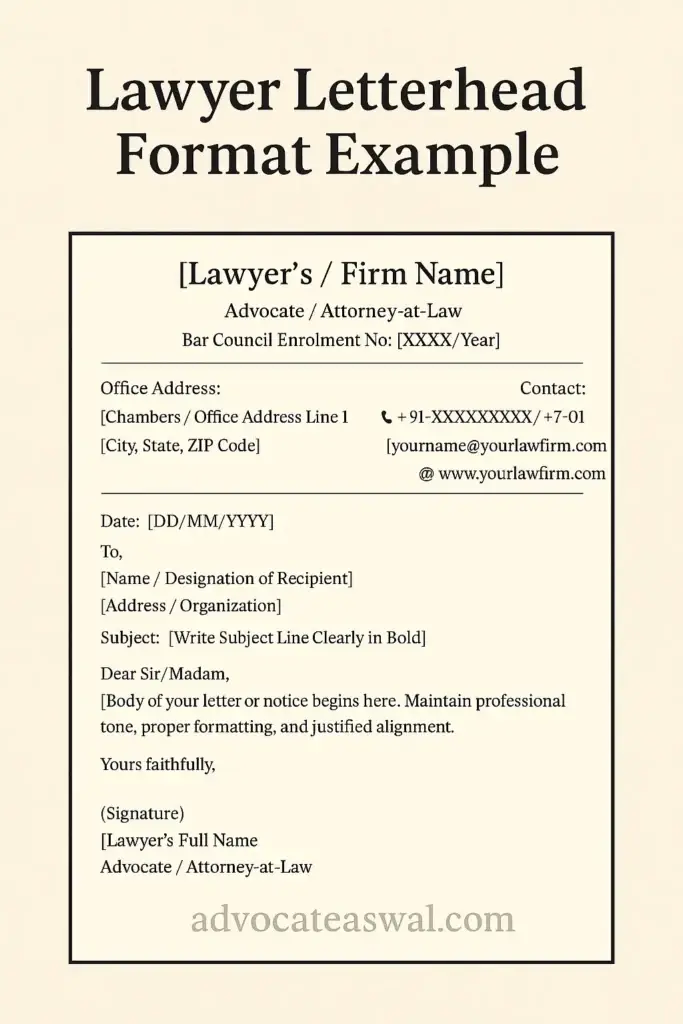
Lawyer Letterhead Format
Example Lawyer Letterhead Format [Lawyer’s / Firm Name] Advocate / Attorney-at-Law Bar Council Enrolment No: [XXXX/Year]
Office Address: [Chambers / Office Address Line 1] [City, State, ZIP Code]
Contact: +91-XXXXXXXXXX / +1-XXX-XXX-XXXX ✉️ [yourname@yourlawfirm.com] [www.yourlawfirm.com]
(Horizontal line separator)
Date: [DD/MM/YYYY] To, [Name / Designation of Recipient] [Address / Organization]
Subject: [Write Subject Line Clearly in Bold]
Dear Sir/Madam, [Body of your letter or notice begins here. Maintain professional tone, proper formatting, and justified alignment.]
Yours faithfully, (Signature) [Lawyer’s Full Name] Advocate / Attorney-at-Law
Format & Design Notes Top Section: Contains your identity — name, title, and Bar registration.
Middle Section: Client communication content area (date, subject, recipient).
Bottom Section: Signature and professional closure.
Margins: Keep at least 1 inch (2.5 cm) margin on all sides.
Alignment: Left-aligned text maintains formal readability.
Pro Tip: Keep your logo (if any) in the top-left or top-center position. Use subtle dividers or lines to separate header and body content — they enhance structure without over-designing.
Sample Lawyer Letterhead Format (Example Template) Designing a lawyer letterhead doesn’t have to be complicated — what matters most is structure, clarity, and balance. Below is a sample layout you can use as a reference. You can easily adapt it for your personal practice or your law firm, whether in India, the USA, or elsewhere.
Conclusion
Building Trust Through a Professional Lawyer Letterhead
Your lawyer letterhead is more than a document header — it’s a reflection of your credibility, consistency, and professionalism. Whether you’re drafting a client notice, a legal opinion, or a court submission, a well-designed professional letterhead gives every communication a sense of authenticity and authority.
A clean design, accurate details, and ethical presentation speak volumes about your practice — even before a single word of your legal argument is read.
It shows that you value order, precision, and respect for formal process — the same qualities that define a great lawyer.
A strong first impression begins with your letterhead — make it professional, make it personal, make it trustworthy.
Frequently Asked Questions (FAQ)
1. What should be included in a lawyer letterhead?
A lawyer letterhead should typically include the lawyer’s name, professional designation (e.g., Advocate / Attorney-at-Law), bar-registration number (where applicable), office address, contact information (phone, email, website), and firm logo or name if applicable. These are the essential components of a professional letterhead.
2. Can I design my own professional letterhead design or should I hire a designer?
Yes, you can definitely design your own professional letterhead design using tools like word processors or template-based design platforms. But if you want a fully custom branding look and ensure highest visual quality (especially for print/digital use), hiring a designer may be a good investment. Rankings.io+1
3. Are there any legal or professional compliance rules I need to follow for a lawyer letterhead?
Yes, in many jurisdictions your letterhead must comply with the professional conduct or marketing rules of your bar association or legal body. For example, it must not be misleading about who can practice law, must show appropriate licensing information, and cannot give false impressions. ncbar.gov+1
4. What font, colour and layout should I use for a lawyer letterhead?
Use clean, readable professional fonts (e.g., Times New Roman, Garamond, Georgia for serif; Helvetica, Lato for sans-serif). Colour palette should be formal and subtle (e.g., black, dark blue, grey, maroon) rather than loud. Layout should keep your header compact, sufficient white space, balanced margins, and contact details aligned clearly. Rankings.io+1
5. Should I have separate versions of the letterhead for print and digital?
Yes — it’s advisable. A print version should be high resolution (300 dpi) and may include full-colour accents; a digital version should be optimized for screen (lighter file size, readable on email/PDF). This ensures your professional letterhead looks consistent and sharp in both formats.
6. How do I make my letterhead design reflect my brand as a lawyer or law firm?
Ensure consistency across all touch-points: use the same logo, colours, fonts, and style on your letterhead, business cards, email signature, website. Decide whether your brand identity is traditional and formal or modern and approachable, and let your letterhead reflect those values.
7. What is the standard size of a lawyer letterhead?
The standard size for a lawyer letterhead is A4 (210 × 297 mm) in India and Letter size (8.5 × 11 inches) in the USA.
Always ensures your layout fits within printable margins and looks uniform on both print and digital formats.
8. Can a lawyer include multiple office addresses on a letterhead?
Yes, but it should be done neatly. If you have more than one office, list your main office first, followed by branch addresses in smaller text or the footer area.
Avoid overcrowding the header — simplicity improves readability and professionalism.
9. Is it mandatory to include the Bar Council number on a lawyer letterhead in India?
While not always legally required, it is strongly recommended to mention your Bar Council Enrolment Number on your letterhead.
It adds authenticity and helps clients verify your credentials, especially in formal correspondence or legal notices.
10. Can advocates in India or attorneys in the USA use design elements or logos on their letterhead?
Yes, but within professional limits.
You may use simple, elegant logos that represent your law firm or initials. Avoid flashy graphics, taglines, or commercial branding.
Bar Councils and State Bars prohibit overly promotional content on legal stationery.
11. What colors are best for a professional lawyer letterhead?
Choose subtle, serious colors like navy blue, dark maroon, black, grey, or deep green.
These reflect trust and authority. Avoid bright or neon colors that appear informal.
12. How can I make my letterhead design look unique yet professional?
Use a minimalist layout with clean lines, a distinct header-footer structure, and modern typography.
You can include a thin color accent or watermark of your logo for identity — just ensure it doesn’t distract from the text.
13. Should I include a website or email on my letterhead?
Yes, including your official email ID and website adds credibility and makes it easy for clients or authorities to contact you.
Use a professional domain-based email like info@yourlawfirm.com instead of personal ones like Gmail or Yahoo.
14. How can I protect my lawyer letterhead from being misused or copied?
Add a faint watermark (around 25–30% opacity) with your website or firm name — for example, advocateaswal.com — in the background.
This discourages unauthorized use while keeping the design visible and professional.
15. Can I use my letterhead for electronic submissions or e-filing?
Absolutely. In most jurisdictions, you can use a PDF version of your lawyer letterhead for online filing, provided it maintains legibility and official formatting.
Ensure the digital version is optimized (under 1 MB) and in PDF format with embedded fonts.
16. What are the best tools to design a professional lawyer letterhead?
You can create your letterhead using:
Canva – ready templates for legal stationery.
Microsoft Word or Google Docs – ideal for simple, editable formats.
Adobe Illustrator / Photoshop – for custom, high-end designs.
Online legal design platforms – offer India/US-based templates with compliance in mind.


