
Cyber Fraud या Digital Fraud होने के बाद पहले 30 मिनट में क्या करें?
Introduction
Digital Fraud can happen to anyone. A person may lose money through a fake UPI request, phishing link, fake customer-care call, online investment scam, OTP fraud, or a fake identity. When such an incident happens, the first 30 minutes can be very important. Instead of panicking or arguing with the fraudster, take quick and practical steps to report the transaction, secure your accounts, and preserve the evidence.
This article explains what you should do immediately after Cyber Fraud or Digital Fraud in India, where you can report it, what evidence you should keep, and what mistakes you should avoid.
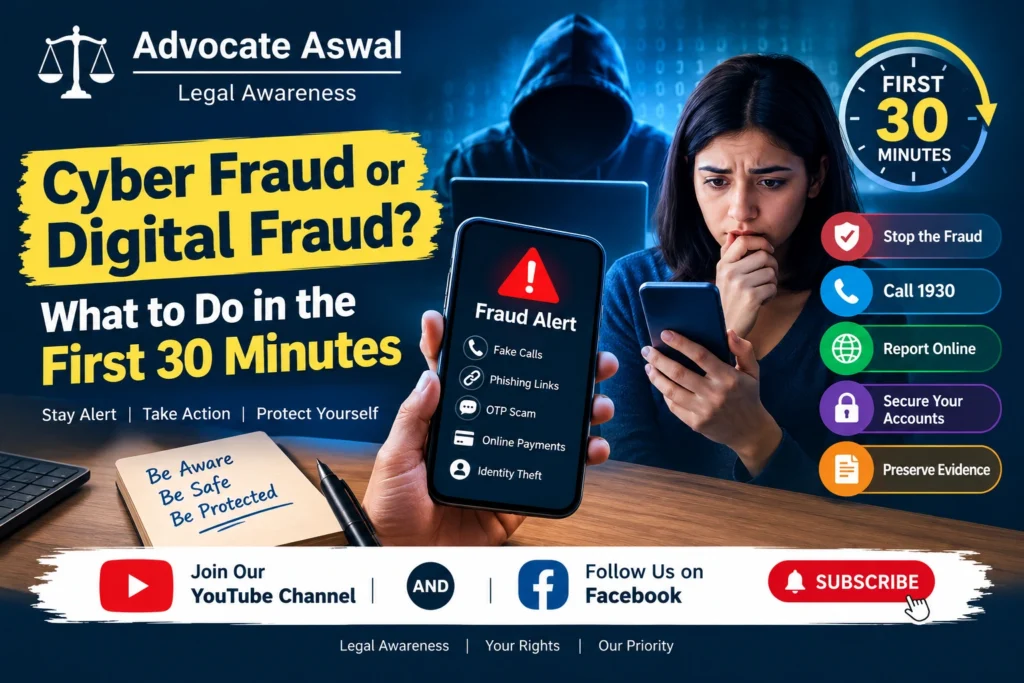
What Should You Do in the First 30 Minutes After Digital Fraud?
If money has been taken from your bank account or you have shared sensitive information with a fraudster, follow these steps as soon as possible.
- Stop the Communication With the Fraudster
Do not continue arguing with the person who contacted you.
Do not:
Share another OTP.
Share your UPI PIN.
Give your card details.
Install another application at their request.
Allow screen sharing or remote access.
Send additional money because they promise to return the earlier amount.
If the fraudster is still communicating with you, save the relevant messages and other details before blocking the number or account.
- Call 1930 Immediately for Financial Cyber Fraud
If you have suffered an online financial fraud, call the National Cyber Crime Helpline at 1930 as soon as possible.
The Government of India provides the 1930 helpline for reporting financial cyber fraud. Quick reporting can help the authorities and financial institutions take steps under the applicable process.
You should keep transaction details ready while making the report.
Keep these details ready:
Your name and mobile number
Bank name
Transaction date and time
Amount lost
Transaction ID/UTR
UPI ID, if applicable
Fraudster’s mobile number
Bank account details, if available
Screenshots and messages
Important: Calling 1930 should not be treated as a guarantee that the money will be recovered. The result depends on the facts, timing, transaction trail, investigation, and action taken by the concerned authorities and financial institutions.
- Report the Fraud on the National Cyber Crime Reporting Portal
You can also report cyber crime through the official National Cyber Crime Reporting Portal:
National Cyber Crime Reporting Portal — cybercrime.gov.in
The portal allows citizens to report different types of cyber crimes. Financial fraud can be reported through the appropriate category.
When making the complaint, provide accurate information.
Do not exaggerate the facts.
Explain:
What happened.
When it happened.
How the fraudster contacted you.
What information was shared.
How much money was lost.
Where the money was transferred.
What steps you have already taken.
Clear and factual information can make the complaint easier to understand.
- Contact Your Bank Immediately
After reporting the fraud, contact your bank or the relevant payment service provider immediately.
Tell them that the transaction is disputed or fraudulent and provide the transaction details.
Depending on the circumstances, the bank may have procedures for reporting unauthorized transactions and taking protective action.
If your card, internet banking credentials, UPI credentials, or other account information may have been compromised, ask the bank about appropriate security measures.
Remember: Do not wait for the cyber complaint process before informing your bank. Both steps should be taken as quickly as possible.
- Secure Your Bank and Digital Accounts
If you have shared your password, banking credentials, email password, or other sensitive information, take steps to secure the affected accounts.
Consider:
Changing compromised passwords.
Logging out of unknown devices or sessions.
Blocking a compromised card where necessary.
Contacting your bank.
Reviewing recent transactions.
Enabling two-factor authentication where available.
If a fraudster obtained access to your email account, secure the email account as well because email access can sometimes be used to reset passwords for other services.
- Do Not Delete the Evidence
This is one of the most important steps.
Many victims delete WhatsApp chats, SMS messages, emails, screenshots, or social-media conversations because they are embarrassed or angry.
Do not delete potentially relevant evidence.
Preserve:
WhatsApp chats
SMS messages
Emails
Screenshots
Phone numbers
Email addresses
Social-media usernames
Profile URLs
Website URLs
UPI IDs
Bank transaction details
UTR/transaction numbers
Payment receipts
Call details available to you
Any suspicious application or file information
Where possible, preserve the original electronic information instead of relying only on edited or cropped screenshots.
- Take Screenshots — But Preserve the Original Information Too
Screenshots can be useful for recording what appeared on your screen.
However, a screenshot is not necessarily the complete electronic record.
For example, if you receive a suspicious WhatsApp message, preserve the relevant chat and other available information rather than keeping only one cropped screenshot.
Electronic records may be subject to legal requirements regarding their admissibility and proof. The Bharatiya Sakshya Adhiniyam, 2023 contains provisions relating to electronic and digital records.
Therefore:
Preserve the original digital evidence wherever possible.
- If You Shared Your OTP or UPI PIN, Act Immediately
If you have disclosed an OTP, UPI PIN, password, card information, or other sensitive banking information to a fraudster, do not wait to see whether something happens.
Immediately contact the concerned bank or service provider and explain what information was disclosed.
Take appropriate steps to secure the account.
A simple rule:
The moment you realise that sensitive information has been compromised, take action.
- What If the Fraudster Used a Fake Customer-Care Number?
Fake customer-care scams are common.
A person may search online for a customer-care number and accidentally contact a fraudulent number.
The fraudster may then ask for:
OTP
Card details
UPI PIN
Screen sharing
Remote-access application
Payment
If this happens, follow the same immediate steps:
Stop communication → Contact your bank → Call 1930 → Report on the Cyber Crime Portal → Preserve evidence.
- What If You Have Been Cheated Through an Online Investment?
Online investment scams may involve promises such as:
Guaranteed returns
Very high profits
Exclusive investment opportunities
Fake trading platforms
Fake cryptocurrency schemes
Fake financial advisors
Pressure to deposit more money
If you realise that you have been cheated:
Do not send additional money to “release” your previous money.
Fraudsters may later contact victims pretending to be recovery agents, police officers, lawyers, bank officials, or government officials and demand another payment.
Verify any such claim independently.
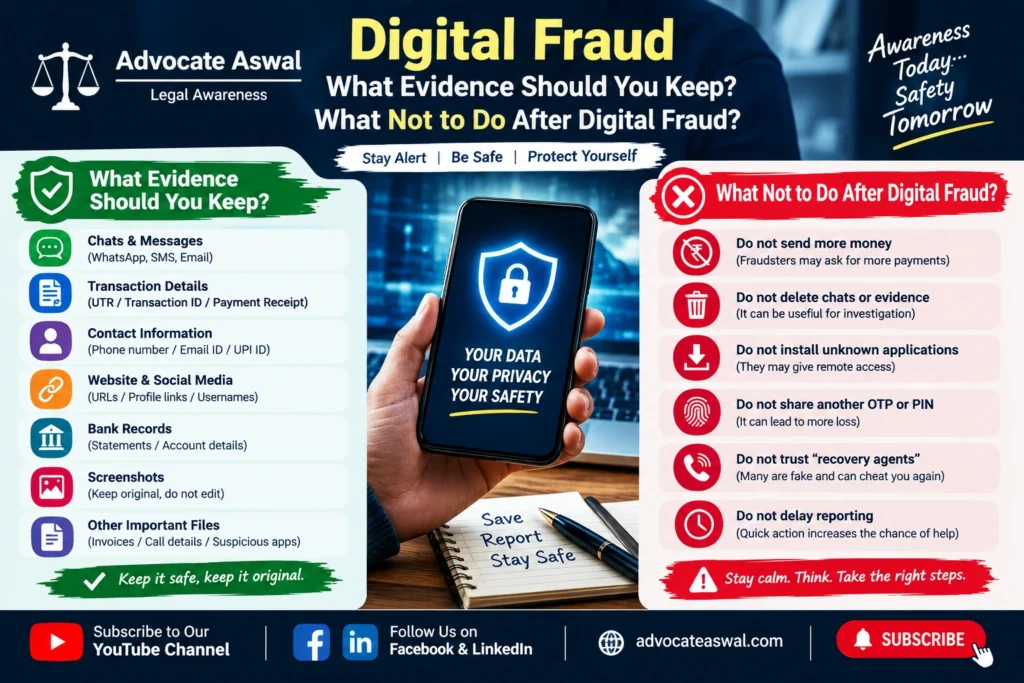
What Not to Do After Digital Fraud
After a cyber fraud, victims often make mistakes because they are under stress.
Avoid these mistakes:
❌ Do not send more money
A fraudster may say that another payment is required to recover your money.
❌ Do not delete the chats
They may contain useful evidence.
❌ Do not install unknown applications
Remote-access applications can create additional security risks.
❌ Do not share another OTP
One mistake should not become a second one.
❌ Do not trust “money recovery” agents automatically
Someone claiming that they can recover your money is not necessarily genuine.
❌ Do not delay reporting
The sooner you report a financial cyber fraud, the sooner the relevant institutions and authorities can receive the information.
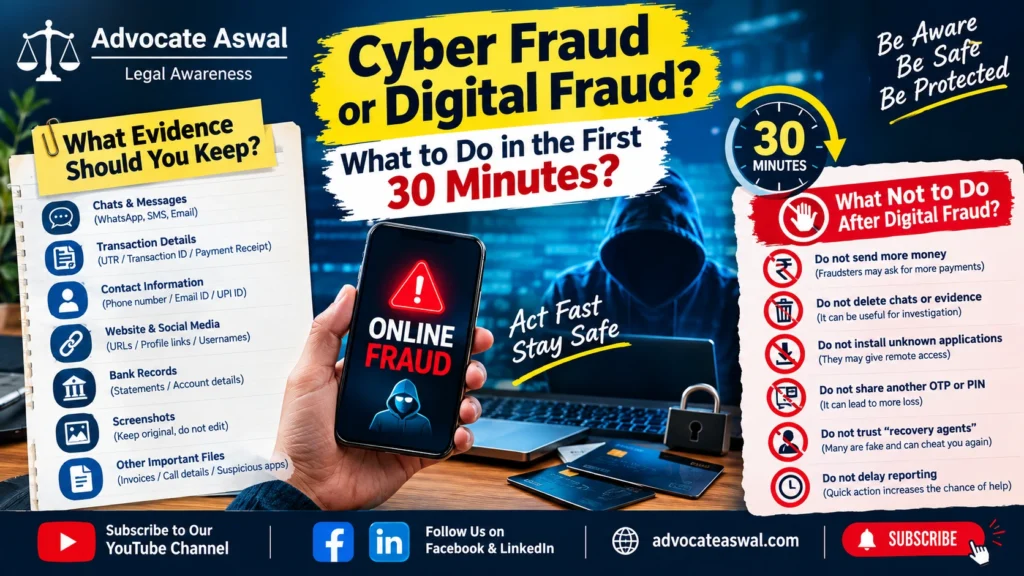
What Evidence Should You Keep?
Create a separate folder and preserve all relevant material.
Evidence | Example |
Transaction details | UTR / Transaction ID |
Payment information | UPI ID / bank details |
Communication | WhatsApp / SMS / Email |
Identity information | Phone number / email ID |
Website information | URL / domain name |
Social media | Username / profile URL |
Financial record | Bank statement / payment receipt |
Visual evidence | Screenshots |
Other material | Files, invoices, messages, etc. |
Do not alter the original files unnecessarily.
Can Cyber Fraud Money Be Recovered?
There is no automatic guarantee that money lost through Digital Fraud will be recovered.
Recovery may depend on factors such as:
How quickly the fraud was reported
Where the money was transferred
Whether the funds are still traceable
Whether the recipient account can be identified or restricted
The investigation
Cooperation of financial institutions and intermediaries
The available evidence
The facts of the individual case
This is why immediate reporting is important.
Which Laws Can Apply to Cyber Fraud in India?
Cyber fraud is not governed by only one legal provision.
Depending on the facts, provisions of the Information Technology Act, 2000, the Bharatiya Nyaya Sanhita, 2023 (BNS) and other applicable laws may become relevant.
For example, the Information Technology Act contains specific provisions concerning certain computer-related offences, including:
Section 66C — Identity theft
Section 66D — Cheating by personation using computer resource or communication device
The exact legal provisions applicable to a particular incident depend on the facts, conduct of the accused, nature of the transaction, evidence and other circumstances.
Therefore, a person should not assume that every online fraud case will involve the same sections.
What If the Fraud Happened Through UPI?
UPI fraud can happen in different ways.
For example:
Fake payment request
Fake refund
QR-code scam
Impersonation
Fake customer support
Social-engineering fraud
Unauthorized transaction
If you notice an unauthorized or fraudulent transaction:
Act immediately.
Contact your bank/payment provider.
Report the financial fraud through 1930.
Submit a complaint through the National Cyber Crime Reporting Portal.
Preserve the transaction ID and other evidence.
Keep records of all complaints and communications.
What If Your Social Media Account Is Hacked?
If your Instagram, Facebook, WhatsApp, email, or another online account is compromised:
First, secure the account.
Where available:
Change the password.
Sign out unknown devices.
Enable two-factor authentication.
Check recovery email and phone number.
Inform contacts if the account is being misused.
If the account is being used for fraud, impersonation, threats, or other unlawful activity, preserve evidence and consider reporting the matter to the appropriate platform and authorities.
When Should You Speak to a Lawyer?

A lawyer is not required for every cyber complaint.
However, legal assistance may be useful when the matter involves issues such as:
Large financial loss
Identity theft
Online blackmail
Serious harassment
Misuse of private information
Business-related cyber fraud
Account freezing issues
Complex digital evidence
Police investigation
FIR or court proceedings
A lawyer can help you understand the legal process applicable to your particular facts.
The First 30-Minute Cyber Fraud Checklist
If you remember nothing else from this article, remember this checklist:
⏱️ 0–5 Minutes
Stop the fraud.
Stop communicating with the fraudster.
Do not send more money.
Do not share another OTP/PIN.
Disconnect remote access if applicable.
⏱️ 5–10 Minutes
Secure your accounts.
Contact your bank.
Block or secure affected payment instruments where necessary.
Change compromised passwords.
⏱️ 10–20 Minutes
Report the financial fraud.
Call 1930.
Provide transaction details.
⏱️ 20–30 Minutes
Preserve evidence and submit the complaint.
Save screenshots.
Preserve chats and emails.
Note transaction IDs.
Save phone numbers and URLs.
Report through the official Cyber Crime Reporting Portal.
Most important:
Do not wait until tomorrow.
Frequently Asked Questions
Yes. 1930 is the Government of India’s cyber crime helpline for reporting financial cyber fraud.
You can use the official National Cyber Crime Reporting Portal
https://cybercrime.gov.in/
Yes. You can provide whatever information you have, such as the phone number, UPI ID, transaction details, social-media account, website or other available evidence.
Recovery is possible in some cases, but it cannot be guaranteed. The outcome depends on the facts, speed of reporting, transaction trail, investigation and other circumstances.
No. Depending on the facts, provisions of the IT Act, BNS and other applicable laws may be relevant.
Final Message
A Digital Fraud can happen within seconds, but the response should start immediately.
Do not panic. Do not pay the fraudster again. Do not delete the evidence.
Instead:
Secure → Report → Preserve Evidence → Follow Up
Remember the two important numbers and resources:
Cyber Crime Helpline: 1930
National Cyber Crime Reporting Portal: https://cybercrime.gov.in/
Legal Disclaimer
This article is published for general legal awareness and educational purposes only. It does not constitute legal advice and does not create a lawyer-client relationship. Cyber crime laws and procedures may depend on the facts and circumstances of each case. Readers should obtain appropriate professional legal advice for their specific situation.


